Emergency Preparedness Basics: What Every Douglas County Resident Should Know
When disaster strikes, the first 72 hours are on you. Here's how to build a go-bag, stock your home, and stay connected when normal communications fail.

When a wildfire, earthquake, or severe storm hits Douglas County, emergency services can be stretched thin — and the first 72 hours after a disaster are typically when you're most on your own. That's why preparedness isn't just a good idea; it's a community responsibility.
Douglas County ARES volunteers see firsthand what happens when communications break down. Here's what we recommend every resident know before the next emergency.
Build Your 72-Hour Go-Bag
A go-bag is a pre-packed kit you can grab in minutes if you need to evacuate quickly. Keep it near your door or in your vehicle. At minimum, include:
- Water — one gallon per person per day for at least three days
- Food — non-perishable items (canned goods, energy bars, dried fruit)
- First aid kit — bandages, antiseptic, any prescription medications
- Flashlight and extra batteries — or a hand-crank model
- Battery-powered or hand-crank radio — to receive emergency broadcasts
- Copies of important documents — ID, insurance cards, emergency contacts
- Cash in small bills — ATMs and card readers may be offline
- Warm clothing and sturdy shoes — one change per person
- Whistle — to signal for help if you're trapped
Review and refresh your kit every six months. Replace expired food and medications, and update documents as needed.
Printable Emergency Preparedness Checklist
Print this checklist and keep it with your household emergency plan. Check off each item as you complete it, then review it every six months.
72-Hour Go-Bag
- Water for at least three days — one gallon per person per day
- Non-perishable food and a manual can opener
- First aid kit and essential prescription medications
- Flashlight, extra batteries, and a battery-powered or hand-crank radio
- Copies of identification, insurance information, and emergency contacts
- Cash in small bills, warm clothing, sturdy shoes, and a whistle
Home and Vehicle Readiness
- Locate and label gas, water, and electrical shutoffs
- Anchor heavy furniture and secure your water heater
- Store a two-week supply of water
- Keep your vehicle fuel tank at least half full
- Keep a current paper map of Douglas County in your home and vehicle
Family Communications Plan
- Choose a meeting place near home and one outside your neighborhood
- Select an out-of-area contact and make sure everyone has the number
- Review your children's school emergency and reunification plans
- Sign up for local emergency alerts and keep a NOAA Weather Radio available
- Practice your plan with everyone in your household
Local Radio Information
- Write down the DC ARES primary repeater: 146.900 MHz, –600 offset, PL tone 100.0 Hz
- Learn which local AM/FM stations carry Emergency Alert System messages
- Share this checklist with a neighbor, friend, or family member who may need help preparing
Prepare Your Home
Beyond the go-bag, a few simple steps can make your home more resilient:
Know your shutoffs. Locate your gas, water, and electrical shutoffs before you need them. Keep a wrench near the gas meter.
Secure heavy furniture. Bookshelves, water heaters, and large appliances should be anchored to walls — especially important in earthquake country.
Stock a two-week supply of water. Fill clean containers or purchase commercial water storage. The standard recommendation is one gallon per person per day.
Keep vehicles fueled. During a regional emergency, gas stations may run out quickly or lose power. Try to keep your tank at least half full.
Have a paper map. GPS and cell service may be unavailable. A current road atlas or county map is invaluable.
Stay Informed When Normal Communications Fail
Cell towers can be overwhelmed or damaged during a major emergency. Here's how to stay informed when your phone isn't enough:
NOAA Weather Radio
A battery-powered NOAA Weather Radio receiver provides continuous broadcasts from the National Weather Service, including alerts for Douglas County. Look for models with the Specific Area Message Encoding (SAME) feature so you only receive alerts for your area.
Emergency Alert System (EAS)
Tune to local AM/FM stations during emergencies. Douglas County's primary EAS stations carry official alerts from the county Emergency Manager.
Amateur Radio
Licensed amateur radio operators — including DC ARES members — provide backup communications when infrastructure fails. During activations, we support Douglas County Emergency Management and served agencies with voice and digital communications.
Our primary repeater: 146.900 MHz (–600 offset, PL tone 100.0 Hz)
If you're interested in getting your amateur radio license, the ARRL website has study materials and a license exam finder. It's easier than you might think, and it's one of the most practical preparedness skills you can add.
Make a Family Communications Plan
Agree on a meeting place and an out-of-area contact before an emergency happens:
- Choose two meeting spots — one near your home (in case of a house fire) and one outside your neighborhood (in case you can't return home).
- Designate an out-of-area contact — it's often easier to reach someone outside the affected area. Everyone in the family should have this person's number memorized.
- Know your children's school plan — find out how your school district handles lockdowns, evacuations, and reunification.
- Practice the plan — run through it at least once a year so everyone knows what to do.
Douglas County-Specific Resources
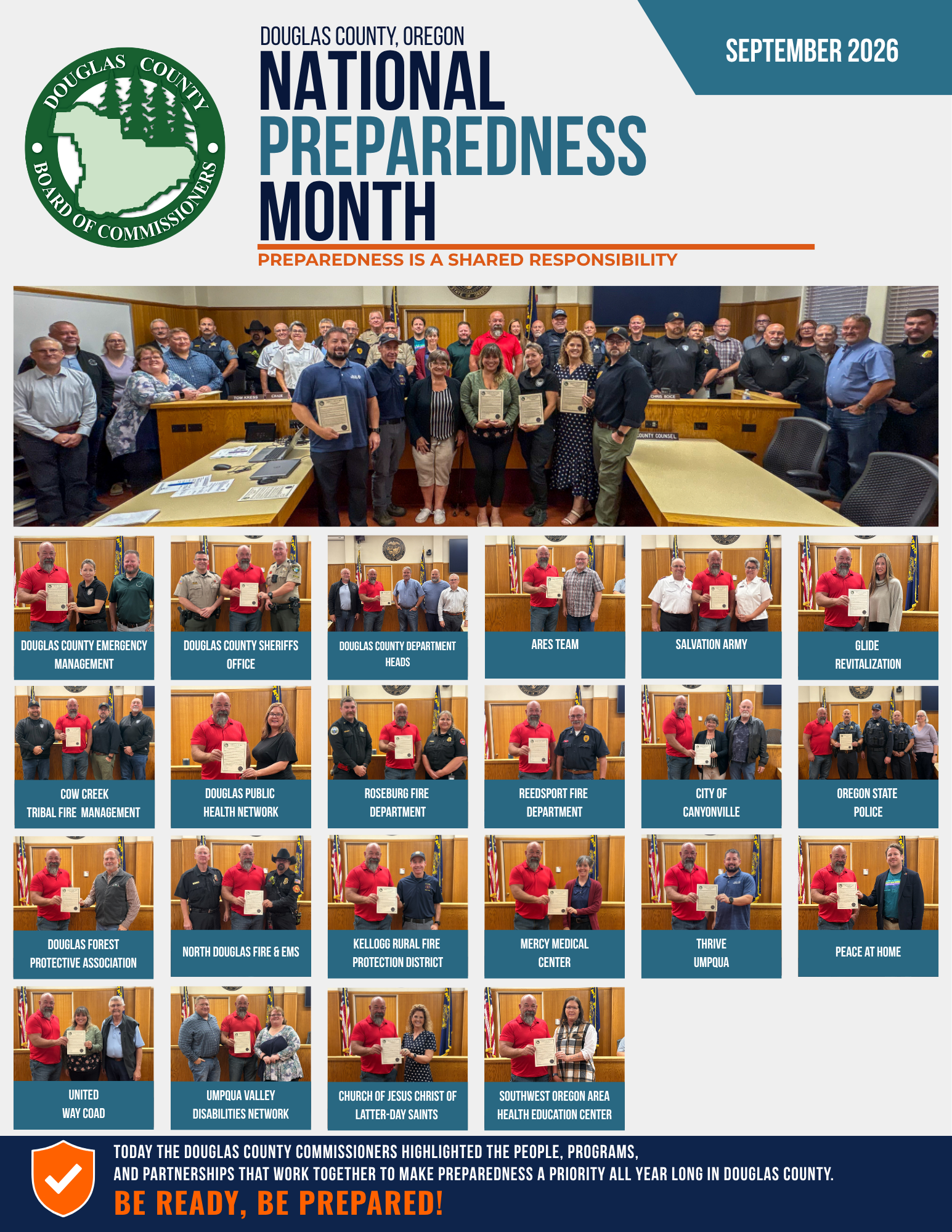
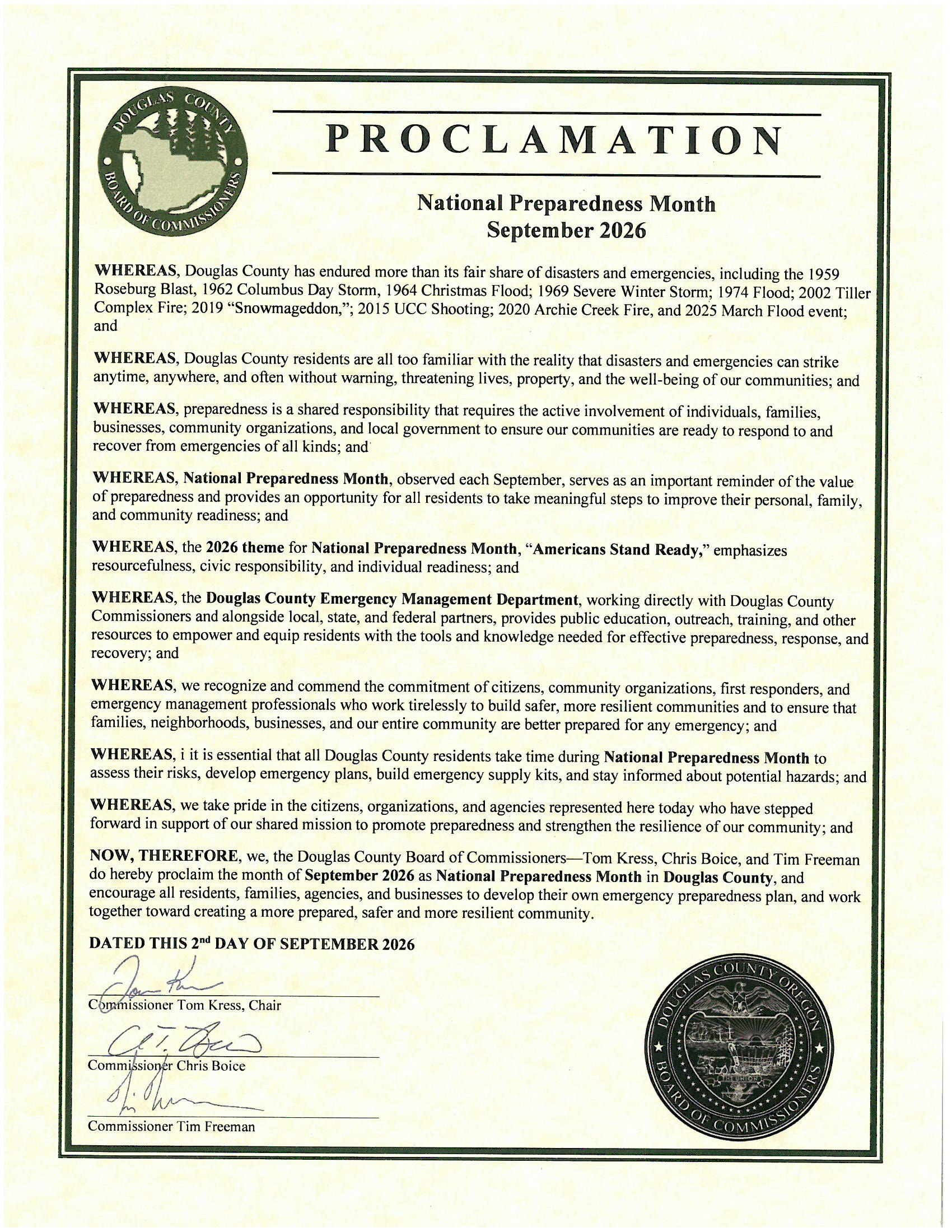
Douglas County Commissioners formally proclaimed September 2026 as National Preparedness Month, recognizing that readiness is a shared responsibility across our community.
- Douglas County Emergency Management: douglascountyor.gov — sign up for emergency alerts
- Oregon Office of Emergency Management: oregon.gov/oem
- Ready.gov: ready.gov — federal preparedness guidance
- DC ARES Emergency Preparedness page: dougcoares.org/emergency-preparedness
Preparedness is a team effort. When neighbors are ready, the whole community recovers faster. If you have questions about amateur radio's role in emergency communications — or want to get involved — reach out to us or join DC ARES.
73 de Douglas County ARES
Explore Topics
Written by
Douglas County ARES
Content creator and writer sharing insights and stories.